/ 01
The honest number
Three to five days. That's the flower.
A cut dahlia, well handled, gives three to five good days in the vase. Handled superbly, on the right variety, you will see seven. Promised a fortnight, you have been reading about a different flower.
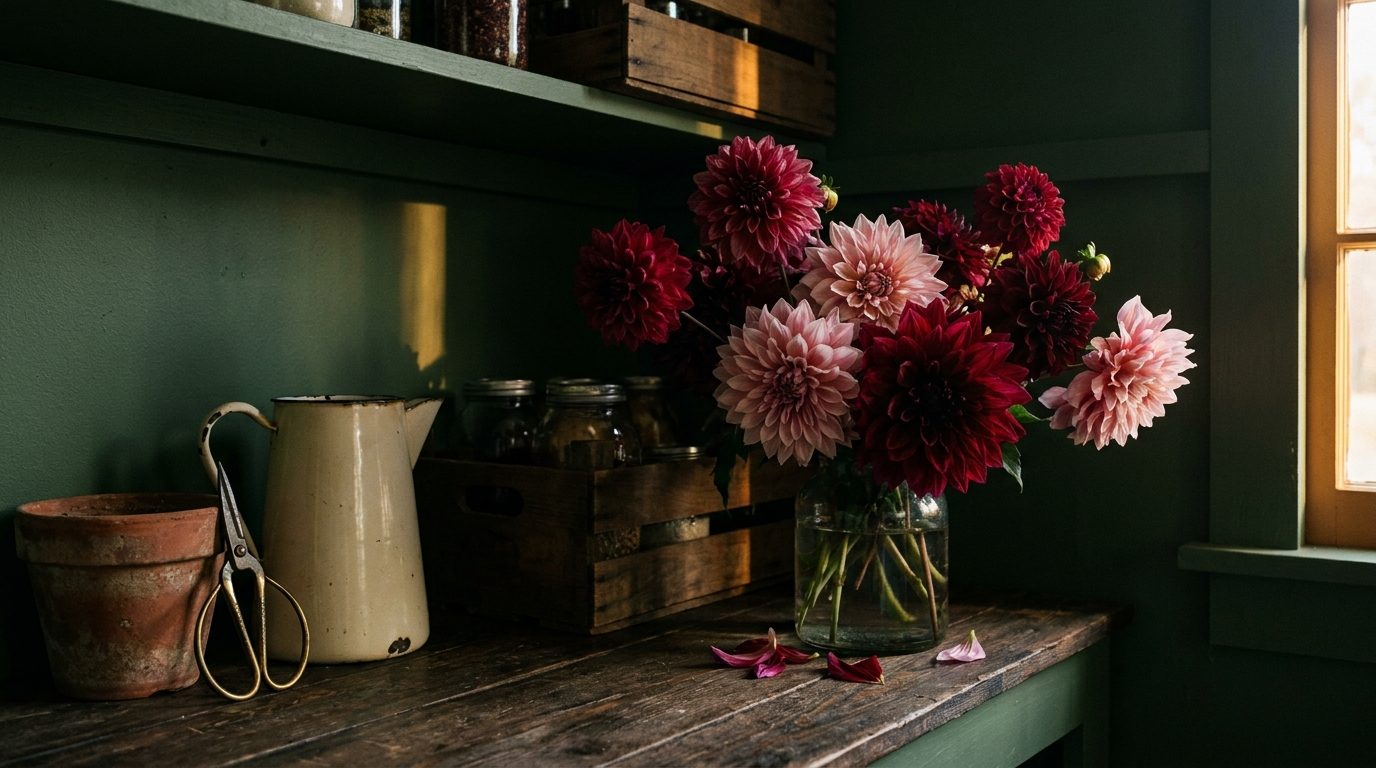
It helps to know why, because the shortness is not a flaw you can fix; it is the deal. A dahlia barely opens further after cutting: what you cut is what you get, a nearly-finished firework rather than a tulip's slow unfolding. It drinks enormously, its hollow stem airlocks easily, and its petals are thin-walled and thirsty. Every one of those traits is also why it looks the way it looks. You cannot have the dinner-plate luxury without the countdown.
A dahlia is a nearly-finished firework. You are not buying longevity; you are buying the best three days in the flower world.
Variety moves the number more than any treatment. As a loose rule the tighter, smaller forms hold longest, ball and pompon dahlias sit at the five-to-seven end, while the huge dinner-plates and open-centred singles drop petals soonest, three days on a good week. If vase life is the brief, choose the form before you fuss the water.
/ 02
In the field
The cut is where vase life is won.
By the time a dahlia reaches a vase its fate is mostly decided. The deciding happens in the bed, at dawn, with the snips.
Cut at the right stage: almost fully open, before the back petals soften. A tight dahlia bud will never open in water, and a bloom whose reverse petals have started to wrinkle is already spending its last day. Cut in the cool, early morning or evening, never in the heat, and get stems into clean water within minutes, not at the end of the row. Strip everything that would sit below the waterline; dahlia foliage fouls water faster than almost anything else we grow.
The one old trick that earns its folklore: hot water. Cut the stem, stand it in a few inches of genuinely hot water, around 60°C, and let it cool for an hour. It clears the airlocks in that hollow stem and firms the whole flower up; on the big dinner-plates it is regularly worth a day. Searing the cut end for a few seconds does a similar job if you are working at speed.
/ 03
The cool chain
Cold is the only real preservative.
Everything else on this page buys hours. Temperature buys days.
| Right cutting stage, cool time of day | the baseline |
| Clean bucket, stripped stems, fresh water | + ½–1 day |
| Hot-water conditioning after the cut | + ½–1 day |
| Overnight in a cool room at 4–6°C | + 1–2 days |
| Vase kept cool, out of sun, water changed daily | + 1 day |
| Flower food | marginal on dahlias; cleanliness matters more |
| Realistic best case, tight-form varieties | ≈ 7 days |
The cool room is the multiplier. A few hours' conditioning at 4 to 6°C after cutting, and cold overnight storage before sale, slows the whole clock down; it is the difference between a flower that leaves your farm on day one of its life and one that leaves on day three. Dahlias do not love long cold storage the way roses tolerate it, so this is a pause button, not a time machine: cut, chill, sell, in that order, inside a couple of days.
No cooler? A north-facing shed floor at night, a cellar, even the domestic fridge for a market-morning bucket all work at small scale. What you are buying is the same thing a commercial cool room buys: fewer degrees, slower breathing, more of the flower's short life spent in your customer's house instead of your holding bucket.
/ 04
Selling it
Why the short life is the local grower's moat.
Here is the commercial punchline: the dahlia's vase life is terrible, and that is precisely why it belongs to farms like ours.
A flower that gives five days cannot spend nine of them in airfreight and a wholesaler's box, which is why the supermarket shelf has no real dahlias on it and why florists buy theirs from growers within driving distance. Every fragile, glorious, short-lived thing we grow is a product the global supply chain physically cannot copy. Sell the freshness like the feature it is: tell customers the honest number, hand them care instructions, and a three-day flower cut yesterday will beat a nine-day rose cut three weeks ago in Kenya on delight every single time.
The operational half of that promise is speed, and speed is a records problem: knowing what was cut, when, and what is sitting in the cool room right now, so nothing sells old. That is the job BloomOS does for us: every cut logged in the field with a timestamp, so the cool room's contents and their ages are simply known, and the per-bed maths runs on the same records. If you are planning next year's dahlia beds, the free crop planning spreadsheet has the profit-per-bed sheet ready for your own numbers.
From the field
Fresh is your advantage. Prove it with records.
BloomOS timestamps every cut as you pick, tracks what's in the cool room, and turns the season into per-bed profit. Free to start, built by a flower farmer, and recruiting a small founding cohort now.