/ 01
The honest number
Three to seven days, and why the range is so wide.
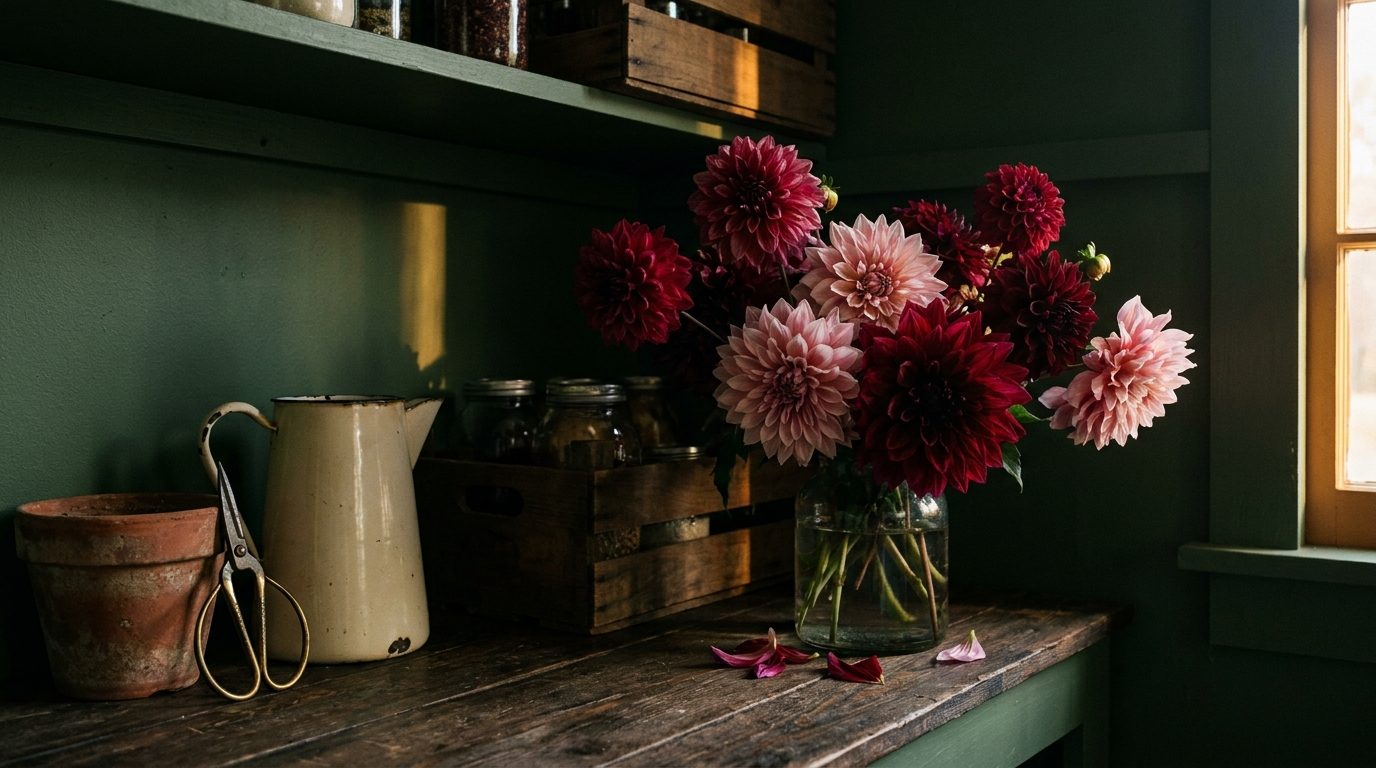
Dahlias are the shortest-lived flower I sell and the one nobody ever regrets buying. The honest range is three to seven days in the vase, and almost everything that decides where a stem lands in that range happens on the farm.
Unlike roses or tulips, a dahlia barely opens after cutting: what you cut is roughly what the vase gets. That single fact drives everything in this piece, when to cut, how to condition, which varieties to trust with a wedding, and it is why supermarket dahlias are rare. They do not ship, they do not wait, and that is exactly the local grower's advantage.
Dahlias cannot be shipped across a hemisphere. They are the argument for buying from a farm like ours, one petal at a time.
/ 02
In the field
Vase life is decided at 6am.
The three field decisions that matter more than anything you can pour into the water afterwards.
Cut at the right stage. Open, or very nearly: a dahlia cut in tight bud stays a tight bud forever. You want the flower three-quarters open with the back petals firm, not papery. Once the back petals soften and reflex, the flower is already old; leave it for the compost bouquet.
Cut cool. Early morning or evening, never into the heat of the day. A dahlia cut at noon in August has lost the battle before it reaches the shade. Straight into clean, cool water in the field; minutes on the barrow floor cost days in the vase.
Cut deep. Take a long stem down to a leaf node even when it means sacrificing side buds, because the plant responds with more long stems, and hollow-stemmed varieties drink better from a fresh angled cut into a node.
/ 03
In the shed
The hot water trick, and what actually helps.
Conditioning is where growers hold the advantage no imported stem can match. It is simple, and it is not optional.
| Hot water dip for cut ends (43 to 60°C), then cool | +1 to 2 days |
| Overnight rest in a cool dark room before selling | +1 day |
| Stripping every leaf below the waterline | +1 day |
| Clean buckets, genuinely clean | +1 day |
| Flower food in the vase | marginal for dahlias |
| The fridge (2 to 4°C, short spells) | helpful, not essential |
Those numbers are field-honest rather than laboratory-grade: stack the first four and a three-day dahlia becomes a six-day dahlia, which is the difference between a customer who shrugs and a customer who reorders. The hot water dip sounds like folklore and is the one I would keep if I could keep only one; a few centimetres of just-boiled-then-cooled water around the stem ends for an hour clears the airlocks that make dahlias flop.
And one myth to retire: searing or flame-sealing dahlia stems is a wedding-day party trick, not a preservation method. Clean cuts, hot water, cold room. Boring wins.
/ 04
Varieties
Some dahlias are simply better at being cut flowers.
Vase life is partly a breeding decision you make in February when the tuber order goes in.
As a rule the tight-petalled forms outlast the glamorous ones: small balls and pompons are the marathon runners, five to seven days without drama, which is why 'Cornel Bronze' and 'Jowey Winnie' earn their beds every single year. Decoratives and waterlilies sit in the middle at four to six days, 'Café au Lait' included, whatever its Pinterest reputation. Dinner plates and open-centred singles are the sprinters, two to four days, cut for the day they are needed and priced accordingly.
If you sell to florists, say all of this out loud. A florist told honestly that the dinner plates are for Saturday's wedding and the balls are for the shop shelf will trust you with both. The variety-by-variety record of what actually lasted, from your beds, in your water, is worth more than any chart on the internet, mine included.
/ 05
On the farm
Track it like the crop it is.
Vase life feels like florist business until you notice it is really a growing record: variety, cut date, stage, and how it held. The farms that know their numbers sell with a straight face.
We keep it simple: every variety gets its honest vase-life range noted alongside its stem counts, and both feed the next tuber order. The dahlias that earn their bed are the ones that produce well and hold well; a variety that gives forty beautiful stems that die in two days is a liability with a fan club. Stem counts per bed is exactly what BloomOS logs from the field, and our free crop planning spreadsheet has a place for the vase-life notes beside the profit maths. If you want the money side of a dahlia bed, every assumption shown, that worked example is here.
From the field
Know which varieties earn their bed.
BloomOS keeps stem counts and variety records from a library of 1,400+ varieties, logged in the field as you cut. Free to start, built by a flower farmer, and recruiting a small founding cohort now.